
 Close-up details 局部特寫
 Close-up details 局部特寫
 Close-up details 局部特寫
 Close-up details 局部特寫
 Close-up details 局部特寫
 Process images of paper's ink-induced shrinkage and wrinkling.
紙張吸墨後收縮變皺的過程影像
Process images of paper's ink-induced shrinkage and wrinkling.
紙張吸墨後收縮變皺的過程影像
 Process images of paper's ink-induced shrinkage and wrinkling.
紙張吸墨後收縮變皺的過程影像
Process images of paper's ink-induced shrinkage and wrinkling.
紙張吸墨後收縮變皺的過程影像
 Process images of paper's ink-induced shrinkage and wrinkling.
紙張吸墨後收縮變皺的過程影像
Process images of paper's ink-induced shrinkage and wrinkling.
紙張吸墨後收縮變皺的過程影像
 Process images of paper's ink-induced shrinkage and wrinkling.
紙張吸墨後收縮變皺的過程影像
Process images of paper's ink-induced shrinkage and wrinkling.
紙張吸墨後收縮變皺的過程影像
 Process images of paper's ink-induced shrinkage and wrinkling.
紙張吸墨後收縮變皺的過程影像
Process images of paper's ink-induced shrinkage and wrinkling.
紙張吸墨後收縮變皺的過程影像
 Process images of the ink stick grinding.
磨墨的過程影像
Process images of the ink stick grinding.
磨墨的過程影像
 Process images of the ink stick grinding.
磨墨的過程影像
Process images of the ink stick grinding.
磨墨的過程影像
 Process images of the ink stick grinding.
磨墨的過程影像
Process images of the ink stick grinding.
磨墨的過程影像
 Process images of the ink stick grinding.
磨墨的過程影像
Process images of the ink stick grinding.
磨墨的過程影像
 Process images of the ink stick grinding.
磨墨的過程影像
Process images of the ink stick grinding.
磨墨的過程影像
Shi Jin-Hua
Video: 4:43 min.
Further images
-
(View a larger image of thumbnail 1
)

-
(View a larger image of thumbnail 2
)

-
(View a larger image of thumbnail 3
)

-
(View a larger image of thumbnail 4
)

-
(View a larger image of thumbnail 5
)

-
(View a larger image of thumbnail 6
)

-
(View a larger image of thumbnail 7
)
-
(View a larger image of thumbnail 8
)

-
(View a larger image of thumbnail 9
)

-
(View a larger image of thumbnail 10
)

-
(View a larger image of thumbnail 11
)

-
(View a larger image of thumbnail 12
)

-
(View a larger image of thumbnail 13
)

-
(View a larger image of thumbnail 14
)

-
(View a larger image of thumbnail 15
)

-
(View a larger image of thumbnail 16
)

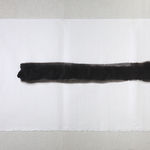
Calligraphy of “一” (One) continues the core concept of Shi Jin-Hua’s Pen Walking series. The practice began with a single, new ink stick. Shi repeatedly ground the ink on an inkstone, dipped his brush, and marked the character “一” in the same position on a single sheet of paper. He repeated this sequence of grinding, dipping, and marking until the ink stick was completely exhausted, at which point the action came to an end.
Through countless layers of overlap, the seemingly stable and simple form of “一” begins to break down. The strokes shift and the ink spreads; as the paper absorbs the ink, it contracts and wrinkles, eventually developing a sculptural quality. In this process, the ink stick and the paper’s surface become a site of transformation between “being” and “non-being,” leaving behind traces of bodily action, accumulated time, and sustained concentration.
Shi Jin-Hua once stated that this work is a practice of “pure art,” echoing Daoist thought while resonating with Buddhist concepts of “emptiness.” The repetition of writing becomes an act of meditation: on how one form transforms into another, how something moves from “being” to “non-being,” and how form emerges once again from a blank surface. For him, this process was both reincarnation and an inquiry into the philosophy and aesthetics of art.
(Compiled and adapted from the artist's writings)
《一字書》延續了石晉華「走筆」系列的核心概念。創作始於一條全新的墨條,石晉華在硯台反覆磨墨、蘸墨,於同一張紙的相同位置重疊寫畫「一」字。他持續重複「磨墨—蘸墨—書寫」的動作,直至墨條完全耗盡,行為才隨之停止。
在無數次的重疊中,「一」這個看似穩定、簡單的形式開始崩解。筆畫位移、暈開,最終紙張吸墨後收縮變皺如雕塑作品。墨條與紙面在此過程中成為「有」與「無」之間的轉換,留下的是身體行動、時間累積與精神專注的痕跡。
石晉華曾表示,這件作品更接近一種「純藝術」的實踐,其內涵與道家思想相通,亦可與佛教的「空性」對話。在反覆書寫的過程裡,一個形式如何轉化為另一個形式,如何由「有」轉為「無」,又如何在空白的紙面上重新生成,對他而言,既是一種輪迴,也是一種哲學與美學的探問。
(文字編整自石晉華相關書寫)