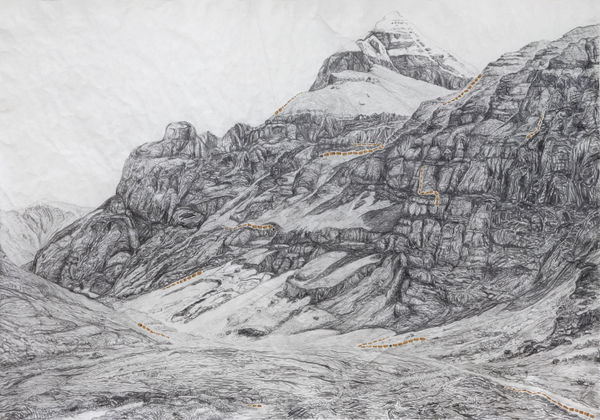
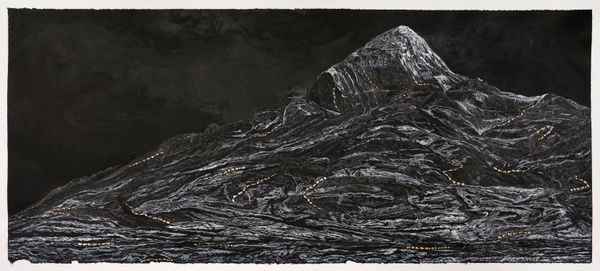
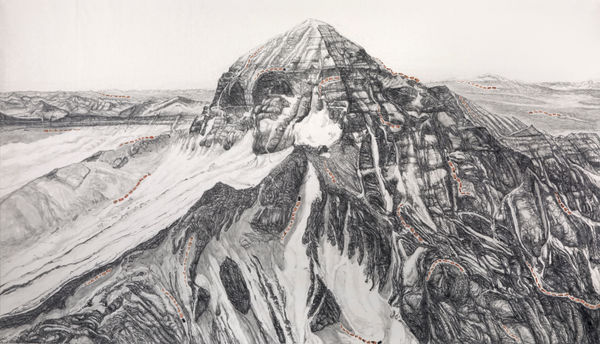
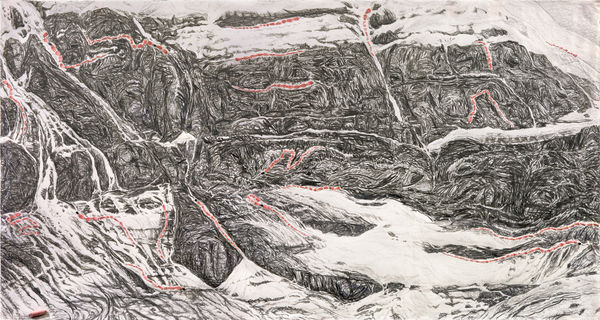
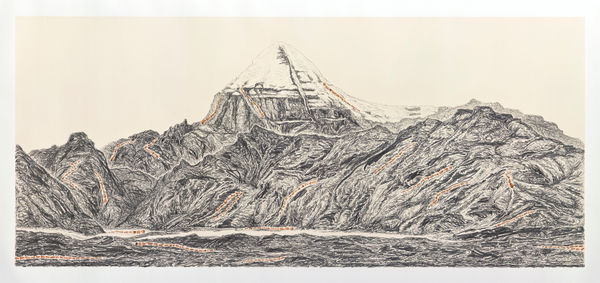
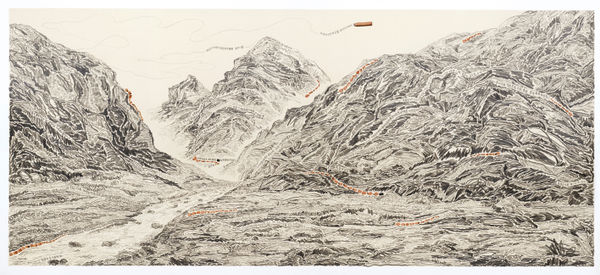
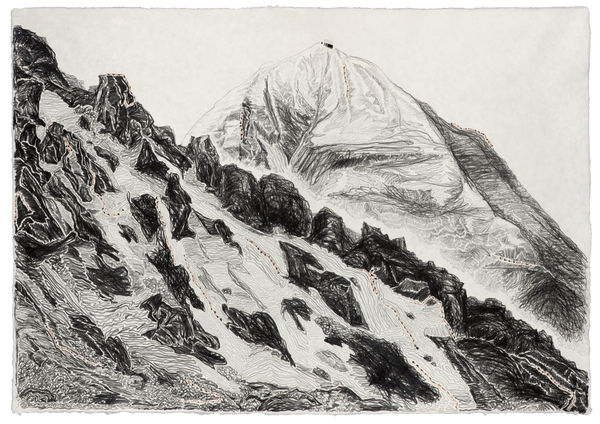
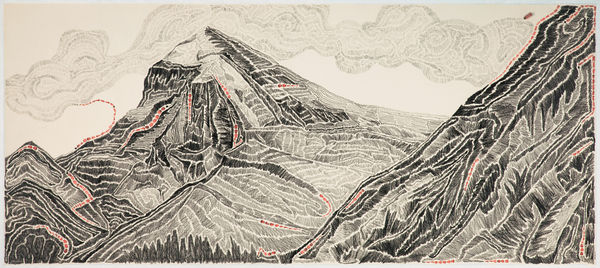
Mount Kailash rises in western Tibet at an elevation of 6,638 meters. Its peak, permanently draped in snow, commands a majestic presence that is both visually and spiritually breathtaking. Great rivers of Asia—such as the Ganges, the Indus, and the Brahmaputra—all trace their origins back to this mountain. It is revered as a sacred mountain and the dwelling of deities by Tibetan Buddhism, Hinduism, Bon (the indigenous Tibetan religion), and Jainism. Innumerable pilgrims journey here from India, Nepal, Bhutan, and Tibet. Devout Tibetan Buddhists walk around the mountain in a clockwise direction, a circumambulation believed to purify the negative karma of their past and present lives, while accumulating immeasurable merit.
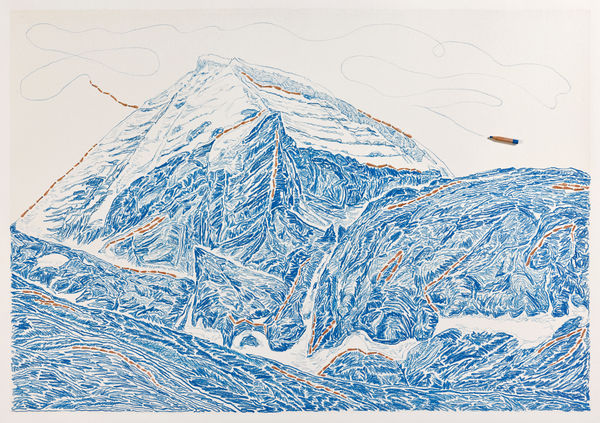
One of the sub-series within "Pen Walking" involves using a single pencil to delineate Mount Kailash, exhausting the entire pencil in the process. Here, I adopted the mountain-climbing narrative from my work "I Try." To me, the mountain serves as a symbol of a transcendent goal beyond the cycle of samsara. Since my physical body could not journey there, I transformed this single sheet of paper into my sacred sanctuary—my "dojo" of pilgrimage. In Buddhism, the act of circumambulation (walking around a sacred object) is both an expression of reverence and a form of spiritual practice. Typically performed around a noble being or a sacred object of veneration, such as a Buddha statue or a stupa, walking in a clockwise direction signifies aligning oneself with the Dharma, symbolizing a mind constantly anchored in the teachings.
In practice, "Pen Walking" around the mountain grants me a loftier vantage point from which to overlook all life experiences, reminding me that this is a journey defined by a destination. This state of concentrated, repetitive action brings profound peace and stillness to my inner self.
The notion of a pencil dedicating its entire existence to walking around a mountain is a beautiful narrative in itself. Through continuous, uninterrupted lines and the accumulation of pencil shavings, we witness a pencil exhausting its life to circumambulate the mountain. This process is a metaphor for devoting an entire lifetime to climbing this spiritual peak. If the goal is not achieved in this incarnation, the journey continues into the next life—into the next pencil. If one lifetime is not enough, one tries again in the next, and the next. As long as one holds this fundamental, resolute vow, one will ultimately come to confront truth, wisdom, and compassion.
(Originally published in the artist's monograph, 2013)
岡仁波齊峰,位於西藏西部,海拔6,638米,峰頂終年積雪,山勢威凜,極具心靈和視覺震撼力。恒河、印度河、布拉馬普特拉河等大江大河均發源於此,它同時被藏傳佛教、印度教、西藏原生宗教苯教,以及耆那教認為是天人與諸神所居的聖山。來自印度、尼泊爾、不丹以及西藏的朝聖人們絡繹不絕,篤信佛教的藏人堅信以順時鐘的方向繞山,能夠滌盡前世今生的罪孽,累積無量的功德。
《走筆》有一系列作品,是以一枝鉛筆走畫出岡仁波齊峰,在這裡我認養了《我試著》裡面爬山的故事。對我而言,這座山是個象徵,代表自輪迴生命中超越的一個目標。我的身體到不了那裡,就用這一方紙做為我朝聖的道場。繞行這個行為,在佛教是個敬禮也是修行,以尊者或崇敬的象徵物,如佛像、佛塔為中心繞行,向右繞行則是表達順於佛法之意,它同時象徵念茲在茲都在於此。事實上,走筆轉山讓我有一個高度,俯瞰所有人生的經歷,提醒我這是一個有目標的旅途,而這個專注與重複的行為,帶給我內心的平靜與安定。
鉛筆的一生完全奉獻繞行一座山,本身就很美。以連續不中斷的線條與鉛筆屑,耗盡一枝鉛筆的走筆轉山,是指以一期的生命來爬這座山,如果沒有達成,就在下一個生命(鉛筆)繼續爬山。如果一輩子做不成,就下輩子再來,再不成就再繼續,只要有一個根本的願力,總有一天我會面對真理、智慧與慈悲。
(原載於2013年作品集)
One of the sub-series within "Pen Walking" involves using a single pencil to delineate Mount Kailash, exhausting the entire pencil in the process. Here, I adopted the mountain-climbing narrative from my work "I Try." To me, the mountain serves as a symbol of a transcendent goal beyond the cycle of samsara. Since my physical body could not journey there, I transformed this single sheet of paper into my sacred sanctuary—my "dojo" of pilgrimage. In Buddhism, the act of circumambulation (walking around a sacred object) is both an expression of reverence and a form of spiritual practice. Typically performed around a noble being or a sacred object of veneration, such as a Buddha statue or a stupa, walking in a clockwise direction signifies aligning oneself with the Dharma, symbolizing a mind constantly anchored in the teachings.
In practice, "Pen Walking" around the mountain grants me a loftier vantage point from which to overlook all life experiences, reminding me that this is a journey defined by a destination. This state of concentrated, repetitive action brings profound peace and stillness to my inner self.
The notion of a pencil dedicating its entire existence to walking around a mountain is a beautiful narrative in itself. Through continuous, uninterrupted lines and the accumulation of pencil shavings, we witness a pencil exhausting its life to circumambulate the mountain. This process is a metaphor for devoting an entire lifetime to climbing this spiritual peak. If the goal is not achieved in this incarnation, the journey continues into the next life—into the next pencil. If one lifetime is not enough, one tries again in the next, and the next. As long as one holds this fundamental, resolute vow, one will ultimately come to confront truth, wisdom, and compassion.
(Originally published in the artist's monograph, 2013)
岡仁波齊峰,位於西藏西部,海拔6,638米,峰頂終年積雪,山勢威凜,極具心靈和視覺震撼力。恒河、印度河、布拉馬普特拉河等大江大河均發源於此,它同時被藏傳佛教、印度教、西藏原生宗教苯教,以及耆那教認為是天人與諸神所居的聖山。來自印度、尼泊爾、不丹以及西藏的朝聖人們絡繹不絕,篤信佛教的藏人堅信以順時鐘的方向繞山,能夠滌盡前世今生的罪孽,累積無量的功德。
《走筆》有一系列作品,是以一枝鉛筆走畫出岡仁波齊峰,在這裡我認養了《我試著》裡面爬山的故事。對我而言,這座山是個象徵,代表自輪迴生命中超越的一個目標。我的身體到不了那裡,就用這一方紙做為我朝聖的道場。繞行這個行為,在佛教是個敬禮也是修行,以尊者或崇敬的象徵物,如佛像、佛塔為中心繞行,向右繞行則是表達順於佛法之意,它同時象徵念茲在茲都在於此。事實上,走筆轉山讓我有一個高度,俯瞰所有人生的經歷,提醒我這是一個有目標的旅途,而這個專注與重複的行為,帶給我內心的平靜與安定。
鉛筆的一生完全奉獻繞行一座山,本身就很美。以連續不中斷的線條與鉛筆屑,耗盡一枝鉛筆的走筆轉山,是指以一期的生命來爬這座山,如果沒有達成,就在下一個生命(鉛筆)繼續爬山。如果一輩子做不成,就下輩子再來,再不成就再繼續,只要有一個根本的願力,總有一天我會面對真理、智慧與慈悲。
(原載於2013年作品集)
-
 Pen Walking #185, 2018-2024
 -
Pen Walking #184, 2021-2023
-
Pen Walking #183: The Tranquil Peak and Serene Ridges, 2022
-
Pen Walking #181, 2021–2022
-
Pen Walking #180, 2015-2022
-
Pen Walking #179 Seeing Compassion Lake Around Mount Kailash, 2021-2022
-
Pen Walking #178 Moon above Mount Kailash at Dawn, 2019-2021
-
Pen Walking #176, 2020-2021
-
Pen Walking #173 The Picture of Unclouded Moon and Blowing Snow, 2019-2020
-
Pen Walking #169: Moonlight over Mount Kailash, 2019
-
Pen Walking #168, 2018-2019
-
Pen Walking #165, 2017
-
Pen Walking #163, 2012–2016
-
Pen Walking #161, 2016
-
Pen Walking #160, 2016-2017
-
Pen Walking #144, 2015
-
Pen Walking #136, 2014
-
Pen Walking #125, 2012
-
Pen Walking #120, 2012
-
Pen Walking #112, 2011
-
Pen Walking #110, 2011
-
Pen Walking #108, 2011
-
Pen Walking #99, 2011
-
Pen Walking #51, 2008